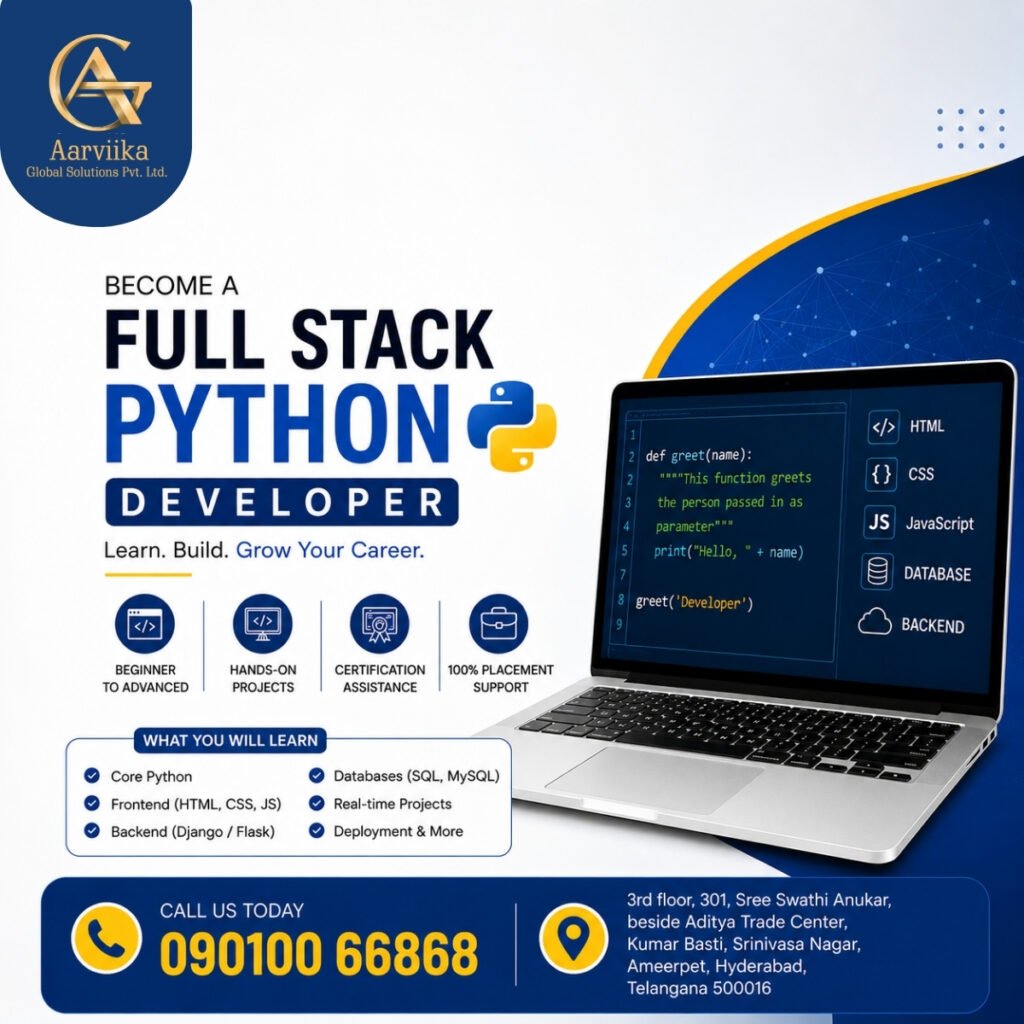
Learn what is Python and Why should you learn Python? and who should learn with this beginner-friendly roadmap covering Python basics
One of the biggest advantages of Python is its relatively simple and readable syntax. This makes it easier for beginners to understand programming concepts while also making Python powerful enough for professional software development, automation, data analysis, artificial intelligence, and web development.
If you are wondering how to learn Python from scratch, what career opportunities it can offer, or what you should learn first, this guide will help you understand the complete journey.
What Is Python?
Python is a high-level, general-purpose programming language used to develop different types of applications and software.
Python was designed with an emphasis on readability, which means its syntax is relatively easy for humans to understand.
For example, a simple Python program can look like this:
name = "Aarviika Global Solutions"
print("Welcome", name)
Output:
Welcome Aarviika Global SolutionsEven someone completely new to programming can understand what this code is doing.
Why Should You Learn Python?
There are several reasons why Python is a good programming language for beginners.
1. Easy-to-Understand Syntax
Python code is generally concise and readable. Beginners can focus on learning programming concepts instead of struggling with complicated syntax.
2. Versatile Programming Language
Python isn’t limited to one particular field. It can be used in:
- Web development
- Data analysis
- Artificial intelligence
- Machine learning
- Automation
- Software development
- Testing
- Scientific computing
3. Large Community
Python has a large global developer community. Beginners can find documentation, tutorials, examples, and learning resources when they need help.
4. Extensive Libraries and Frameworks
Python has a huge ecosystem of libraries and frameworks that help developers build applications more efficiently.
5. Useful for Beginners and Professionals
Python can be your first programming language, but learning Python doesn’t mean you have to remain at a beginner level. It can become the foundation for advanced technical careers.
Where Is Python Used?
Python is used in many different areas of technology.
Python for Web Development
Python can be used to create websites and web applications.
Popular Python frameworks include:
- Django
- Flask
- FastAPI
Developers can use these frameworks to build everything from small applications to large web platforms.
Who Should Learn Python?
Who Should Learn Python?
Students
Students who want to enter the software industry can use Python to build a strong programming foundation.
Beginners
If you have never programmed before, Python is a reasonable language to start with because its syntax is relatively straightforward.
Working Professionals
Professionals can learn Python to automate repetitive tasks or move toward technology-related roles.
Aspiring Developers
People interested in software or web development can use Python as a foundation before learning frameworks and other technologies.
People Interested in AI and Data
Python is particularly useful for people interested in data science, machine learning, and artificial intelligence.
Is Python Easy to Learn?
Python is beginner-friendly, but learning programming still requires practice. Knowing Python syntax alone isn’t enough to become a programmer.
You need to understand concepts such as:
- Variables
- Data types
- Operators
- Conditional statements
- Loops
- Functions
- Lists and dictionaries
- Object-oriented programming
- Error handling
- Modules and packages
The best approach is to learn one concept at a time and practice it with small programs.
Conclusion
Python is more than just a beginner-friendly programming language. It can serve as a strong foundation for many technology careers, including software development, web development, data science, automation, machine learning, and artificial intelligence.
The best way to learn Python is not to rush through hundreds of tutorials. Start with the fundamentals, practice regularly, solve problems, and gradually build real projects.
If you’re starting from zero, remember:
Learn → Practice → Build → Improve.
With consistent practice and the right learning roadmap, Python can become a valuable skill for your technology career.
About Aarviika
At Aarviika, we believe that learning technology should be practical, structured, and career-focused. Our Python learning journey is designed to take learners from programming fundamentals toward practical development skills through concepts, examples, exercises, and projects.
Ready to start your Python journey? Explore Python learning opportunities with Aarviika.